Author: Erin Sarpa

I'm Erin, Co-Founder of EandI Design, a creative agency. I have a passion for finding adventure and bringing a little sunshine wherever I can.

4 things you need to know about running your stationery design business.

My career in design has had some pretty cool twists and turns, from building a successful agency in Silicon Valley to outselling Martha Stewart in online custom stationery. The common factor throughout these 20+ years is that managing the business side of things is absolutely crucial to success. Yep, it doesn’t matter how much of a creative genius you are if you don’t take care of the money, the relationships and the long term strategy.

Meet David Baker (not pictured). I told him I would make him look good if he helped me out. I might've photoshopped him a little.

Meet David Baker (not pictured). I told him I would make him look good if he helped me out.

Many years ago I attended an excellent conference called Mind Your Own Business. The keynote speaker was David Baker, a creative business guru. He is an understated guy but his message was anything but… so my partner and I hired him to do a business review for us that permanently changed the way we ran the shop. We captured an additional $150,000 in revenue that year without working any harder.

So I thought you guys might find some of David’s insights helpful on your path to crazy awesome success… here’s what he had to say:

SHQ: What is the biggest mistake small design firms or freelancers make in business?

DB: 1. Thinking “If I build it, they will come.”

2. Poor Positioning. By positioning yourself as a designer who can do everything in order to be relevant to everyone, instead you become irrelevant. Know you’re specialty and sell it.

SHQ: What are the most important factors for success in a small business?

DB: I tested 14,000+ business owners to find out whether there were common traits amongst those who were very successful. 1,340 of those tested were considered successful and almost every single one was a risk taker.

Along with a willingness to make bold decisions, successful business owners have money smarts. Does a designer go out of business because they are not talented? Almost never. It’s because they don’t have money smarts. DO NOT incur debt at risk of the future of your business. If you need to spend to grow, save it up and be comfortable with the possibility of losing it.

SHQ: What’s a Gorilla client and why are they dangerous?

DB: If you add up your revenue and count how many active clients or partners you have, each one should be between 5% – 25% of that business. 8 to 15 clients is a good number for success. If a client is more than 25% of your business you are approaching the danger zone. If they are over 35% of your business you have both feet in it.

Erin: I have had the Gorilla Client experience twice in my career. Both times we made a lot of money. I mean a LOT of money. The second time the GC was KodakGallery.com, you’ve heard of them right? They filed bankruptcy a few years ago owing us about $100,000 in card royalties. At the time they were about 50% of our revenue. We are still recovering and making damn sure that none of our partners are ever that much of our business again.

Here’s a more in-depth explanation from David about the subject: Gorilla Clients

SHQ: When you do business reviews of creative firms, do you find a common problem that we all seem to have?

DB: It’s common that business owners try to be and do all things. In order for a business to grow, it’s leader needs to focus on strong positioning, getting new business and running the business from a financial perspective.

Erin: If you only read one of David’s articles (and I suggest you spend significant time on his site, he’s got a whole buttload of crucial information for you) read this one: Why Your Firm Might Fail and How to Prevent It


Meet Sarah Schwartz, editor of Stationery Trends

I met Sarah (virtually) recently and it was really no surprise that she is warm, friendly, smart and passionate about stationery. And also has a barking dog that saves it’s energy for when Sarah is on the phone. Just like my dog. While getting to know Sarah it occurred to me that she has a wealth of great info for our stationery designers and she was kind enough to share her thoughts. Make sure you sign up for her blog:  ThePaperChronicles.com – it’s a great snapshot of what’s happening in stationery.
 

SHQ: What’s the best part of being the Editor-in-Chief at ST?

SS: That’s a tough one to answer! I love getting to scope out trade shows, and just experiencing pop culture with an eye to design trends. In reviewing submissions, I love getting to see so much marvelous work — I am often completely flabbergasted by the talent out there.

It is really amazing to see designers rise and thrive. To that end, I always feel very rewarded when I can bring about a business connection, e.g. between an artist and a showroom.

And I love slowly creating the editorial of each issue article by article, image by image, and then seeing it slowly coming to life during production in tandem with the ST team. Often I get so caught up in the entire process that I forget others will even read it. So then when I receive positive feedback from readers, it’s truly rewarding.

SHQ: What trends do you see coming for next year?

SS: I don’t see foil — specifically gold foil, with tones like copper and rose gold important too — slowing down at all, though I think pared-down presentations of this or any design trend are most dazzling & enduring. Overall, I think anything that bears the touch of the hand resonates — we are seeing something of an artisanal backlash to the digital age.

SHQ: What’s the best way to get products in the hands of retail buyers, high profile blogs and publishers without sounding desperate?

SS: I would find my targets and approach them accordingly, e.g., not with one big, one-size-fits-all, mass push. So, do your homework — e.g., find out who to approach at that retail venue and reach out to them individually, tailoring your query to the spirit of their brand. If you want to be a specific magazine, look at the masthead and find out who the right editor is. Same would go for blogs & publishers. I think everyone appreciates being approached by someone who knows a little bit about how each company operates and its distinctive way of delivering what it delivers. For me, I like to receive an email query telling a little bit about a given item, with the offer of sending a sample if I’m interested.

In your correspondence, spell the first & last names right, spell “stationery” right — and let them know you’ll follow up after say a week. If you don’t hear back, try to be patient and understand they’ve most likely got a pretty full plate. The occasional follow-up is fine, but take care to not cross the line into stalkerdom.

And while there’s nothing wrong with talking up your line — promoting oneself is to be lauded after all — don’t focus on your sales pitch so intensely that you are not open to any advice that may fall on your plate. Finally, if you take that advice and modify your line, reach back out — giving full credit to your new mentor of course! And if any of this doesn’t pan out, it is really hard not to take rejection personally — but keep reaching out and eventually you will find a good fit.

Personally, for almost every vendor that approaches me, I usually try to find the best spot to showcase their line, which can take time. For that reason, I always get a kick out of including someone in ST who submitted imagery a few issues back. I think most magazines, stores and blogs try to tell a story with what they share — so even if you don’t fit into the one they’re telling, you may well fit into the next one.

SHQ: When do magazines, blogs and retailers start scouting for holiday themed items?  How far ahead of the game do we have to be?

SS: Hmmm, that’s going to vary. ST doesn’t really follow the consumer calendar — it is targeted toward buyers and retailers, so we start thinking about winter holiday for our summer issue (which I start working on in spring if you can believe it!).

For my blog, I start thinking about holiday when consumers do — typically fall, though hopefully I’ll have started planning it a bit earlier. Since it drives their bottom lines, retailers I think always have holiday in the back of their mind — they’ll start planning at the summer gift shows — but if they think they can move one of your items, and you can deliver it quickly, they may incorporate it into their mix even after the selling season has started.

SHQ: What do retailers tell you that they wish stationery designers understood about their business?

SS: Oooh, another hard one! I think having a brick and mortar, or even an online venue, has gotten so challenging of late. A lot of retailers dislike it when wholesalers selling direct to consumers — they feel it undercuts their chances of succeeding with a given product line. That is a common complaint, but one I hear less and less these days. I do think smart (and therefore more successful) retailers know their distinctive mix, presentation, expertise and customer service attracts and retains their clients —they’re not going to see an Etsy shop as a serious threat. But they do love it when their vendors promote them on social media! And they love it if they can be the only one carrying a line within a certain radius, say 20 miles. I also think the more they know about the story of the artist or line, the better they can romance it.

 
 pc-logo-final-web
Sarah Schwartz is the founding editor and editor-in-chief of Stationery Trends, an award-winning, design-focused trade quarterly magazine devoted to all things paper. In producing each issue, Sarah reviews a huge volume of work encompassing both up-and-coming designers and established industry icons, plus many in between. She travels to trade shows around the world to spot emerging trends and is a frequent industry speaker — her seminars at National Stationery Show are typically standing room only and sell out each year. Sarah has been quoted extensively in the media and blogs at ThePaperChronicles.com. After graduating from NYU, she worked in various editorial positions in publishing including a stint in HarperCollins’ illustrated book division. Sarah lives in Ohio with her husband, young daughter and small dog.

Designing for Back to School

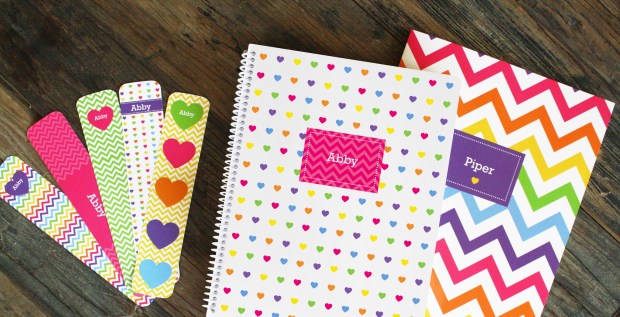
RainbowChevron_SchoolSet

Rainbow Chevron collection by Simon+Kabuki

Summer has historically been a quiet time in the design business but we’ve developed a really nice bump in orders since we started creating back to school products. StationeryHQ.com offers binders, folders, notebooks and lunch boxes for resale so you could be enjoying this extra revenue too. Back to school supplies are a $27 BILLION business in the U.S.

When I’m not working on SHQ’s product line or marketing efforts, I’m working on licensed art. Our collections have graced back to school products at Office Max and Target and we do a lot of personalized school stuff for frecklebox.com.

Here’s what I know about designing for school:

– Bright colors outsell muted colors. By a lot.

– Kids are super trendy, so even if you hate owls, foxes, peace signs or whatever they’re into this year, include those elements in your art and someone will buy them.

– If you’re doing personalized stuff, make sure the kid’s name is the focal point. The moms who are buying love their kids’ names. Subtle won’t sell, particularly when the customer is seeing a thumbnail on her iphone.

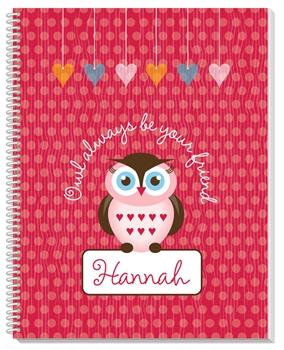
I really hated the owl trend. And this design has made use more money than any other. Ugh.

I really hated the owl trend. And this design has made us more money than any other. Ugh.

– Think about design in terms of how it can represent a kids’ interest or personality in a positive way. That’s something we can all feel good about.

Workin’ it: building your stationery biz

awesomesauce copyAside from being the Creative Director for SHQ, I’m a stationery designer just like you. I got started way back with online custom stationery when we launched with TinyPrints.com and now our brand – Simon+Kabuki – is carried by Design Design, Target Stores, Leanin’ Tree and others. So when I was forwarded an email by one of our awesome reps with a link to a good blog article about ways to get around purchasing the full Adobe Suite (if you aren’t ready for the commitment or can’t afford it yet) it occurred to me that we have lots of good info and resources to share with you guys.

Here are a few things that I know:

1. I could not make my living without Adobe software so I throw down the big bucks about every other upgrade but if you need a workaround solution, it’s out there. Check out this article: http://lifehacker.com/5976725/build-your-own-adobe-creative-suite-with-free-and-cheap-software

2. The National Stationery Show in NYC should be attended at least once in your career. You’ll meet awesome people, be inspired and get a good understanding of what the competition and marketplace is like. You kind of need two days to really walk the show or a really comfy pair of super cute shoes. If you are traveling, book a hotel early to get the best deal and walking distance location. Getting a cab at certain times of day sucks.

3. If you’re really serious about your stationery business then having a booth at the show should be considered. We had a 10 x 10 booth for Simon+Kabuki and the cost of booth space, travel, furnishing, samples, and presskits was in the neighborhood of $15 – $20k. But we were coming from California and we kind of really went for it. If you’re considering showing, there’s a group of smart designers that have a workshop called Tradeshow Bootcamp to help you prepare for the show and learn more about your business.

4. If this is how you make your living, you’ll need to design for what will sell, not just what makes you happy. Save the happy stuff for your personal collection so you don’t have to get pissed when a junior level team member with an accounting degree tells you that she doesn’t really like green, it reminds her of vegetables. And remember that what sells for one partner or region may not be the same as in another place. Your customers will push for what they believe will sell so if they are asking for it, it’s not a bad idea to deliver. We’ve been totally shocked by some of our designs that made us the most money. Sometimes our partners knew better than us. Crazy, I know.

5. Relationships with your peers and vendors are as important as the ones you share with your clients. Get involved in some good online communities, read the best publications (you probably already read Stationery Trends, but if you don’t, you should) and develop a relationship with your suppliers. The paper peeps, press repair guys and ink suppliers at StationeryHQ.com are really important to the health of our business, the more they know us the better equipped they are to help us out when there’s a rush or let us know when we could be doing a better job.

And last but not least, don’t ever quit designing. Whether it’s for cold hard cash or to warm your crazy heart, it’s what you need to do be you. I told my husband this morning that I’m going to paint our perfectly nice kitchen cabinets. He replied, “Cuz you’re a psycho and you need another project?” and I said, “Yes.” Then he said, “okay, just wanted to make sure there was a good reason.”

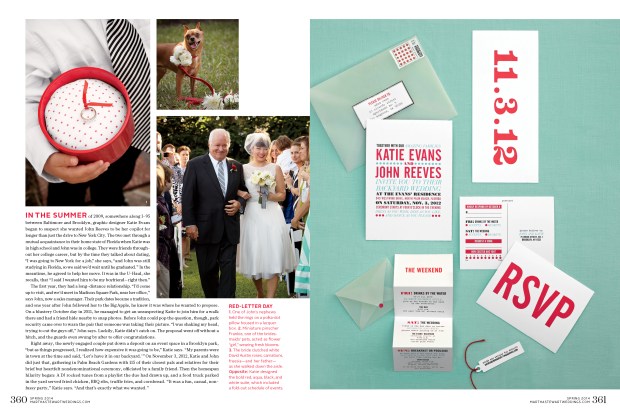
Check out our sassy print work in Martha Stewart Weddings.

RW_florida2

A bold wedding suite set the tone for a beautiful occasion.

RW_florida4

Great use of our different products to go along with an amazing event.

Designer and super awesome client Katie Evans has had quite a year. First she tied the knot, then she had her wedding and designer fabulousness featured in MarthaStewartWeddings.com. Katie took advantage of our high quality digital printing and double thick paper to make a statement, along with bold, happy colors and truly inspired typography. She also took advantage of our stickers to put on cute treat bags and our large sized gift wrap to do a ginormous menu and photo backdrop. Great ideas to continue a theme and stay in budget!2014MSW_spring